Bible Burning Bushes
The Word of God – the Bible – continuous to be the most read book in history. It is the foundation for the Jewish (Tanakh, basically the Old Testament) and the Christian faiths (Old and New Testaments). Jesus Christ is also identified as the Word of God –the Logos. He is God. So, the Word of God is identified with Christ – communicating and revealing God and bringing us close to God. The Bible is the truth that enlightens us holistically to understand the reality of existence, who we are, and how we should live: holistically.
Bible.com is an excellent resource – on the web and through its iOS and Android apps.
It has many versions of the Bible in different languages. It is filled with references and notes. For some versions you can also hear the Bible (audio) while reading it. Check the versions on: https://www.bible.com/versions?page=1 .
For the past several years, I have been going through Bible in One Year plans that were just excellent. For this, I relied on one of the plans suggested by Bible.com’s (YouVersion): https://www.bible.com/reading-plans/34130-bioy23en
Hand Illustration
The Bibliographical Test
More surviving manuscripts than any book in history.
Historians judge an ancient text by two measures: how many copies survive, and how little time separates those copies from the original. By both measures the New Testament stands in a class of its own — not by a little, but by orders of magnitude.
Bars for classical works to scale; the New Testament bar runs off the chart.
| Work | Written | Earliest copy | Time gap | Manuscripts |
|---|---|---|---|---|
| New Testament | c. AD 50–100 | c. AD 1251 | ~35–100 yrs | 5,800+ Greek 20,000+ all langs |
| Homer Iliad | c. 800 BC | 3rd c. BC2 | ~500 yrs | ~1,757 |
| Demosthenes | c. 300 BC | c. AD 1100 | ~1,400 yrs | ~200 |
| Caesar Gallic Wars | c. 54 BC | c. AD 900 | ~950 yrs | ~10 |
| Plato Tetralogies | c. 400 BC | c. AD 900 | ~1,300 yrs | ~7 |
1 Papyrus P52 (John Rylands fragment); a first-half-2nd-century date is standard, though some scholars argue for a wider range. 2 Earliest substantial copies are Ptolemaic papyri; the earliest near-complete medieval manuscript dates to the 10th c. AD.
No body of ancient writing, the historian F. F. Bruce concluded, comes anywhere near the New Testament for the sheer wealth and quality of its surviving textual witnesses. — Paraphrasing F. F. Bruce, The New Testament Documents: Are They Reliable?
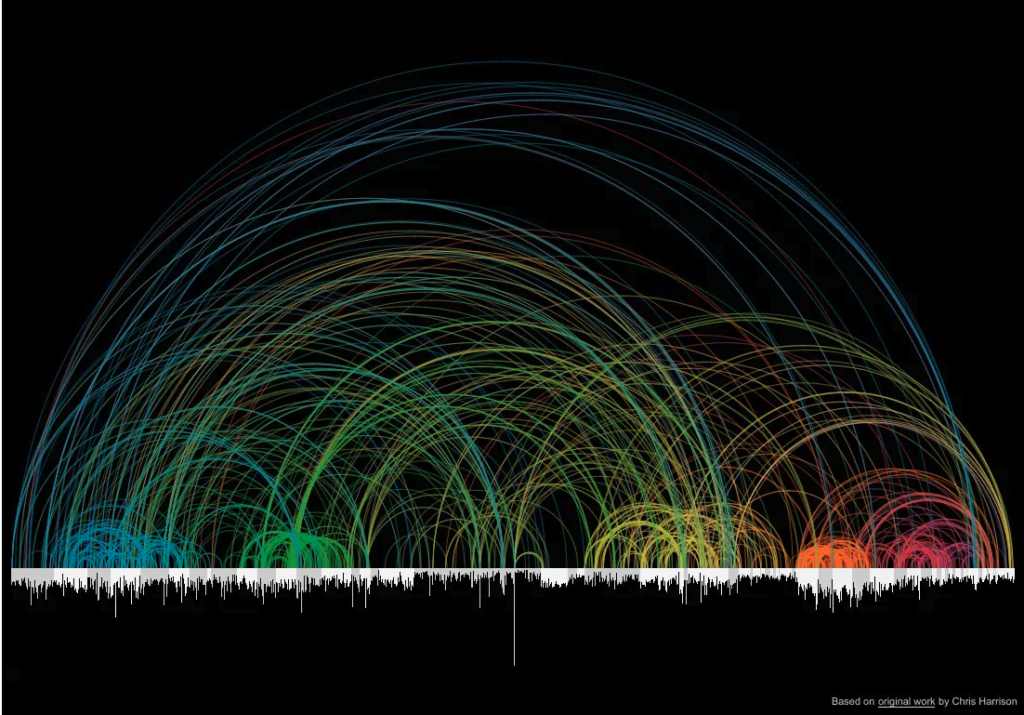
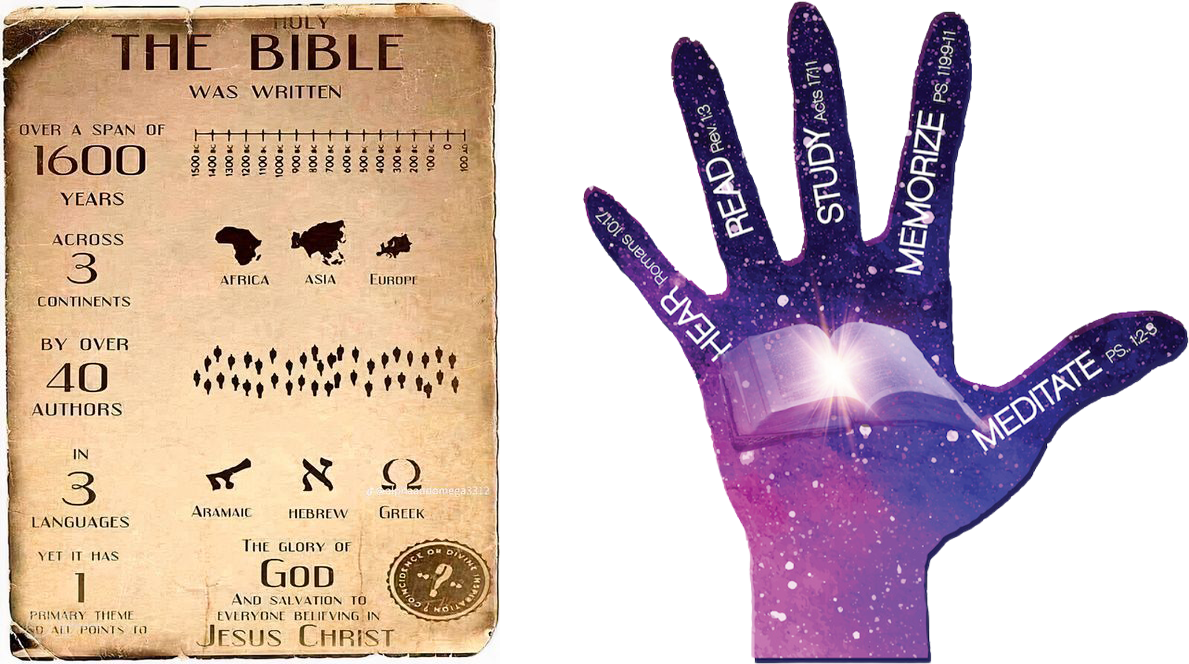
66 books. 40 authors. 1,500 years. One unbroken conversation.
The Bible was written by dozens of hands across fifteen centuries — shepherds, kings, fishermen, prophets — who never met. Yet its chapters answer one another tens of thousands of times. Explore every one of those links below.
A cross-reference is a thread — a shared name, promise, prophecy or image that ties one passage to another. The promise made to Abraham reaches David, then the prophets, then finds its answer in Christ. The Tree of Life planted in Genesis 2 is still standing in Revelation 22. No committee coordinated this across fifteen centuries; the pattern was simply there to be found.
Interactive arc diagram — Robert Rouse, Bible Cross-References (Tableau Public). Cross-reference data — openbible.info, from the Treasury of Scripture Knowledge, licensed CC BY (openbible.info). Arc-diagram method — C. Römhild & C. Harrison, 2008 NSF/Science Visualization Challenge (Christianity Today).