

How much of your trading life should you hand to a centralized platform, and where does verification (KYC) actually change the equation? That question reframes two related but distinct decisions: first, whether to complete OKX’s identity verification and accept centralized custody and regulatory controls; second, whether to trade futures on OKX with leveraged positions. These are not purely technical choices; they alter counterparty risk, margin mechanics, regulatory exposure, and the operational steps you must take to log in, authenticate, and keep access. Below I unpack the mechanisms behind OKX verification and futures, correct common misconceptions, and give practical heuristics US-based traders can use before clicking “verify” or opening a 10x+ position.
Many readers come with partial intuitions: that KYC is just paperwork, that higher leverage is merely faster gains, or that exchanges are interchangeable. In practice those simplifications hide important trade-offs. Verification changes withdrawal and dispute pathways, ties accounts to identity-based controls, and can unlock product sets (like higher-leverage futures); futures expose you to both market and funding dynamics that are very different from spot exposure. I start from how OKX implements these features, then move to where they matter most in routine trading and risk management.
How OKX verification works — mechanism, purpose, and practical consequences
At the mechanism level, OKX’s identity verification (KYC) system requires a government-issued ID and a facial recognition liveness check. The liveness check is designed to link the submitted document to a live human rather than a static photo. That linkage is essential for AML compliance, for law-enforcement requests, and for internal fraud controls. In practical terms, completing KYC on OKX typically unlocks higher withdrawal limits, fiat on-ramps, margin and derivatives products, and simpler customer support pathways when something goes wrong.
Two common misconceptions deserve correction. First: “KYC only helps the exchange.” False in the narrow sense; KYC primarily serves regulatory compliance and the exchange’s legal posture, but it also materially affects user options. For example, certain futures tiers, margin products, and fiat channels are often gated behind completed KYC. Second: “KYC guarantees safety.” It does not. Verification does not remove counterparty risk; your assets held on a centralized exchange remain subject to custodial control, operational incidents, or policy-driven freezes. OKX mitigates operational hacks by keeping over 95% of assets in air-gapped cold storage with multi-signature approval — a strong institutional control — but KYC is not a security panacea for user errors like phishing or weak 2FA.
For US users, regulatory nuance matters. AML and identity controls in the US are stricter than in many jurisdictions; as a result, expect more thorough KYC steps and stricter matching rules (name, photo, and ID consistency). That can mean slower verification turnarounds and a higher chance that a document or selfie will be asked for again. If you plan to use OKX for derivatives, plan ahead: complete KYC before markets you want to trade become volatile, because access delays during fast-moving markets can be costly.
OKX futures: product mechanics, leverage trade-offs, and where things break
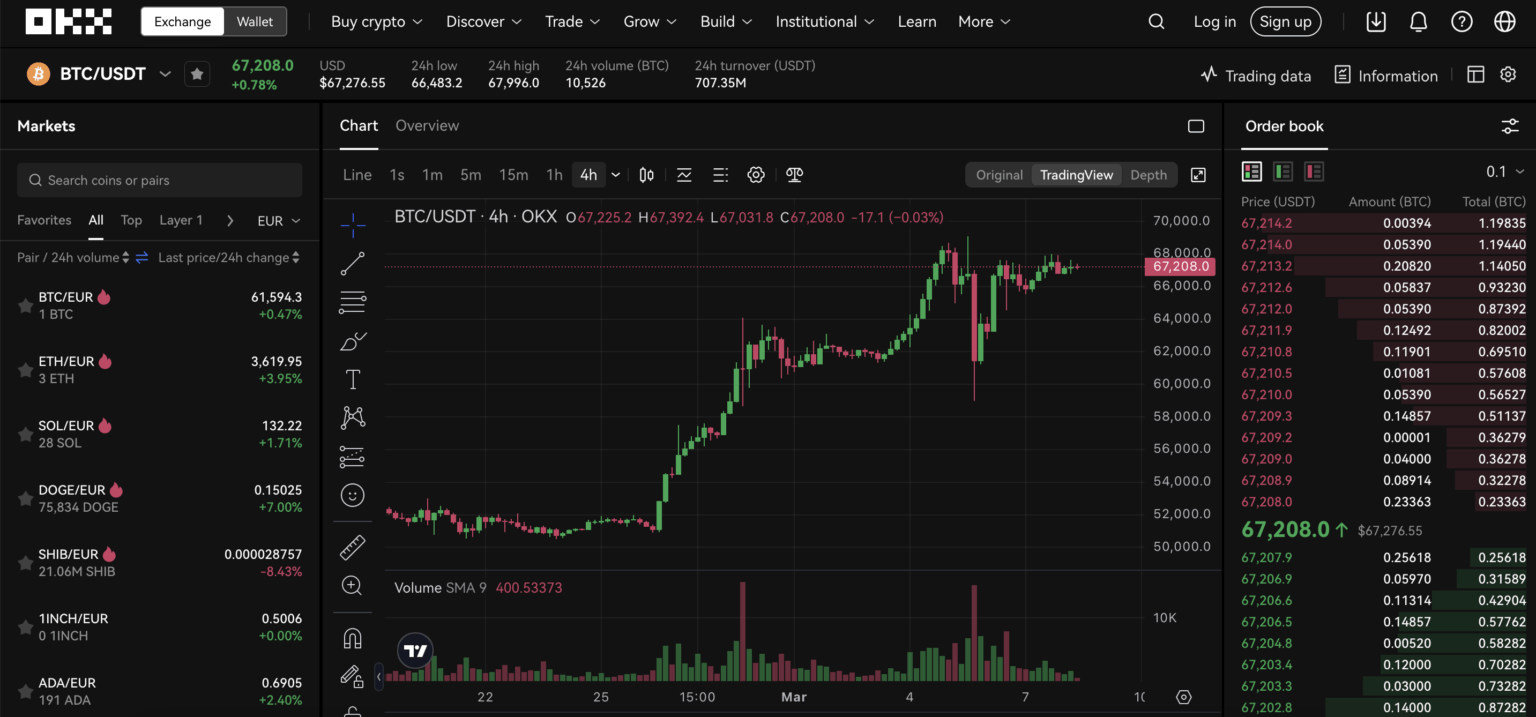
OKX offers a spectrum of derivatives: quarterly futures, perpetual swaps, and options, with leverage up to 125x on some instruments. Mechanically, perpetuals use a funding-rate mechanism to anchor contract price to spot; futures may settle periodically. Higher leverage magnifies both profit and loss on the same directional move and compresses the margin cushion. That compression changes the dominant risk mode: from execution-slippage in spot trading to liquidation risk in futures.
Two trade-offs matter for every trader. First, liquidity vs. leverage: the most liquid instruments (BTC, ETH) typically offer the tightest spreads and deepest order books, allowing large positions with lower slippage even at higher leverage. Low-volume alt perpetuals may allow high nominal leverage on paper but will create wide bid-ask spreads and volatile liquidation cascades in stress. Second, complexity vs. control: isolated margin confines risk to a particular position, while cross-margin can use an entire wallet to prevent a single position from liquidating; cross-margin reduces the risk of immediate liquidation but increases the risk that multiple positions or assets will be consumed if the market moves against you suddenly.
Where does the system break? Two modes stand out. During extreme volatility, funding rates can swing, liquidity can evaporate, and slippage can make post-liquidation re-entry expensive. Also, delistings (OKX recently removed several spot pairs) remind traders that listed token universes change; perpetual or quarterly instruments can face rapid re-pricing or forced settlement if an underlying loses liquidity. These are not theoretical: routine delistings are a governance tool for exchanges to maintain orderly markets, but they can strand positions in thinly traded tokens if you are not monitoring platform announcements.
Login, account protection, and operational hygiene for US traders
Logging in to OKX is straightforward but the operational security posture matters: the platform uses military-grade encryption, AI-driven real-time detection for suspicious logins, and mandatory Two-Factor Authentication (2FA) via SMS, Google Authenticator, or biometrics. The mobile app supports biometric login, which reduces friction but also ties security to your device. For US-based traders, best practice is a layered approach: hardware-backed 2FA where possible, unique passwords stored in a reputable manager, and a self-custodial backup of recovery credentials for any Web3 wallet you control.
If your goal is simply to access OKX products and move funds, the quickest path is to use this official login guidance: okx. But don’t treat speed as a substitute for verification planning. If you intend to use futures, complete KYC and link a secure 2FA method before entering leveraged trades — that minimizes lost opportunity costs caused by verification delays during fast markets.
Misconceptions, boundary conditions, and a practical heuristic
Common myth: “Leaving assets on an exchange is always unsafe; withdrawals to self-custody are superior.” The truth is conditional. Self-custody eliminates custodial counterparty risk but introduces custodial responsibility: lost seed phrases are irreversible. OKX’s cold storage model reduces hack probability for custodial holdings, and Proof of Reserves gives transparency about backing ratios. Choose based on intended use: short-term active futures trading requires exchange custody; long-term passive staking or storage arguably favors a split strategy with self-custody for core holdings and exchange custody for operational funds.
Practical heuristic for US traders: divide your capital into three buckets — operational (liquidity for trading, on-exchange, KYC-complete), opportunistic (smaller exchange exposures for quick trades, keep limits low), and core reserve (self-custody hardware wallet). This framework clarifies when KYC and exchange services are beneficial versus when self-custody reduces systemic risk in your portfolio.
What to watch next — signals and conditional scenarios
Three signals will change the calculus in the near term. First, regulatory shifts in the US around stablecoins or derivatives could modify product availability or KYC requirements; any rule changes would tighten identity controls and potentially narrow leverage for US users. Second, liquidity trends: if more trading concentrates in major assets, exchanges may delist low-volume pairs more aggressively (as OKX recently did), which increases the operational cost of holding small-cap tokens on-exchange. Third, on-chain transparency: wider adoption of Proof of Reserves-like practices could increase user confidence in custodial balances, but it does not obviate operational security or counterparty policy risk.
These are conditional scenarios: none are guaranteed. The practical response is simple — plan verification early, align custody with use case, and adjust leverage according to both liquidity and the margin model you choose.
FAQ
Do I need KYC to trade OKX futures?
Yes: to access most derivatives and higher withdrawal or deposit limits you will typically need to complete KYC, including ID upload and facial liveness. The verification ties your trading privileges to an identified account and affects what products and limits are available to you.
Is it safer to keep funds on OKX because they use cold storage?
Cold storage and multi-signature controls reduce large-scale remote-hack risk, but safety is relative. Exchange custody removes user-controlled key risk but adds counterparty and policy risks. For long-term holdings, many traders prefer a hardware wallet for core reserves; for active futures trading, exchange custody is typically necessary.
How does leverage on OKX affect liquidation risk?
Higher leverage reduces the price movement buffer before liquidation. That means smaller adverse moves can wipe your margin. Liquidity and funding-rate volatility amplify this effect. Use position sizing, stop-loss discipline, and consider isolated margin to contain single-position risk.
What happens if a token I hold on OKX is delisted?
Delisting processes vary: exchanges may stop spot trading for a pair, provide a withdrawal window, or convert balances in special cases. Routine delistings aim to maintain market quality, but they can complicate access to thin tokens, so monitor announcements and avoid leaving illiquid alt holdings inactive on-exchange.
Final takeaway: verification and futures on OKX are tools with specific mechanisms, benefits, and limits. KYC unlocks services but does not eliminate custodial risk; futures magnify returns but replace execution risk with margin and liquidation risk. For US traders, the single most useful habit is planning — complete verification before markets get active, match custody to use case, and size leverage in proportion to both instrument liquidity and your operational readiness.